
Chapter 1: The Cradle of Light (The Sirius System)
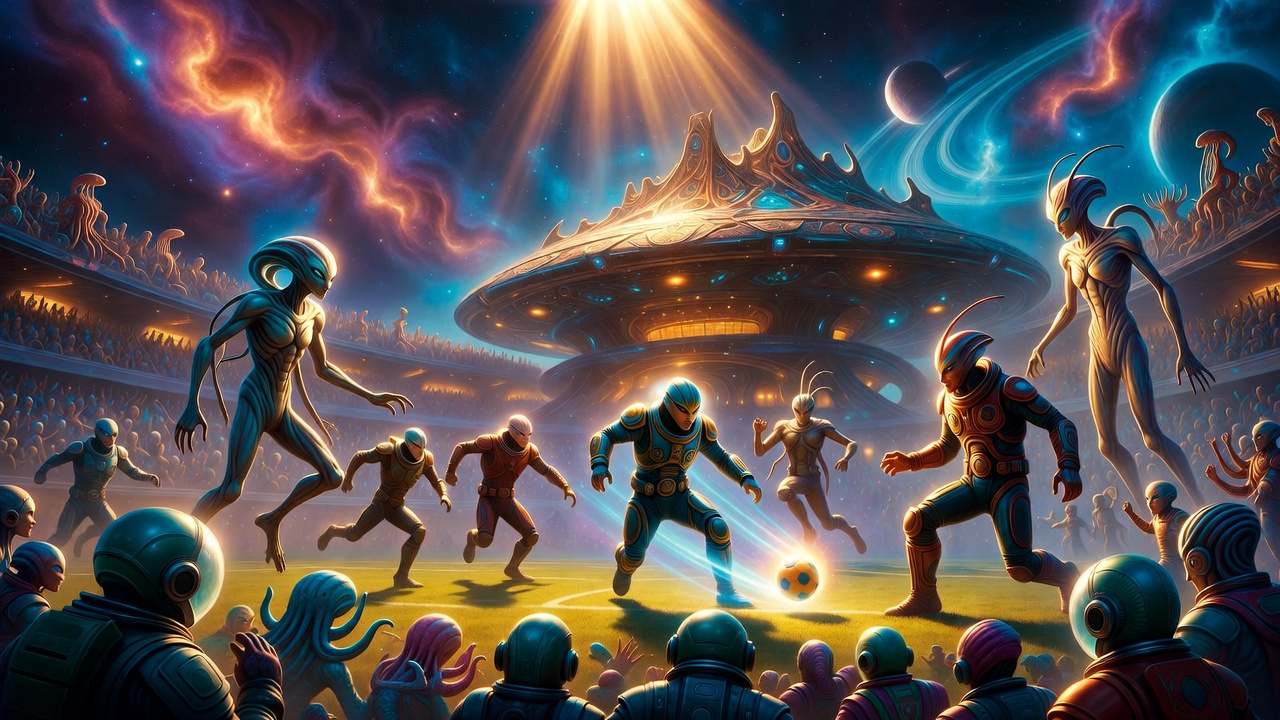
The universe knows no silence; it only knows different frequencies. In the Sirius system, where a binary star scorches any biological thought, life exists in the form of pure vibration. There dwell the Ethereal Leviathans—beings whose bodies are woven from magnetic lines and stellar wind. The youngest among them was Neo. His name, in the language of flares, meant “He Who Seeks the Source.”
For Neo, the cosmos was a transparent ocean. He swam between Sirius A and Sirius B, catching photon streams with his tail. But Neo was different. While his kin enjoyed the perfection of stellar fire, he listened to the “noise” coming from the dark corners of the galaxy.
One day, having tuned his internal resonator to a frequency of 15 Hertz, he heard it. It was not the song of stars. It was the song of water. A heavy, thick, moist vibration drifting from a tiny blue dot near a yellow dwarf. It was the voice of Earth. Neo had heard this voice weakening over the decades. He heard the great singers of the ocean—the humpback whales—vanishing one by one under the strikes of harpoons and the roar of engines.
But on March 3, 2026, something changed. A wave of joy that traveled through space was so powerful that Neo felt it from a distance of 8.6 light-years. It was a signal: “We survived. We have returned.” In that moment, Neo understood his mission. He was to become a bridge between two oceans—the stellar and the earthly.
Chapter 2: The Great Compression (Preparing for the Journey)
The journey to Earth required a radical transformation. An ethereal being cannot simply dive into an ocean—it would evaporate it. Neo began the process of “Biological Condensation.”
For several Earth months, he gathered atoms scattered in space. He used the gravity of giant planets as a press to compress his plasma essence into a carbon form. It was a painful process. Imagine an ocean trying to fit into a single drop. His light-memory was being recorded into the double helix of DNA, and his consciousness was learning to operate within the limited volume of a mammal’s brain.
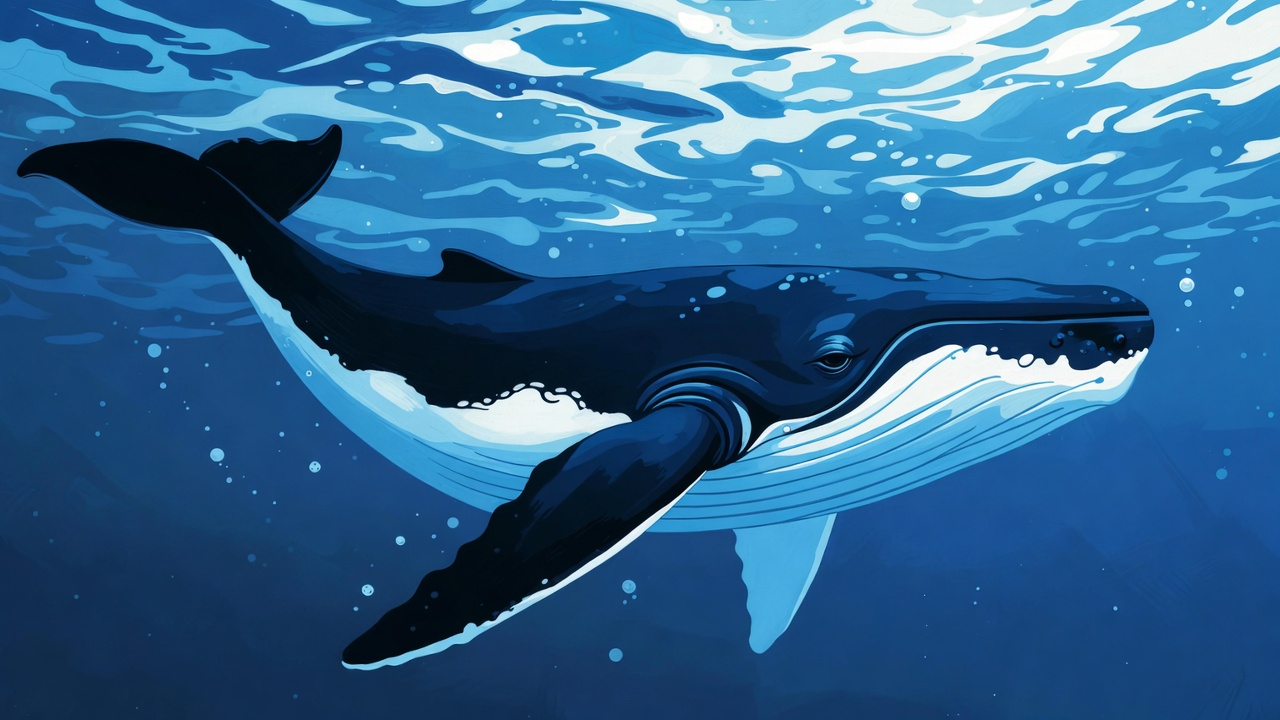
He created for himself the body of a humpback whale, but not an ordinary one. His skin was infused with metals from the hearts of supernovae, giving him a faint silvery shimmer. His eyes retained the color of the blue giant Sirius. His heart was tuned to resonate with Earth’s magnetic field.
Chapter 3: Leap Through the Void
Neo did not use ships. He became a “Quantum Jumper.” Using the solar wind as a sail, he glided along the folds of space-time.
He flew past Jupiter, whose storms reminded him of childhood games on Sirius. He passed Mars, looking with sadness at the red desert that once also held oceans. The closer he flew to Earth, the stronger he felt the pull. Not just physical, but emotional. His whiskers (vibrissae), which were now hypersensitive antennas, caught millions of signals: from the whisper of plankton to the noise of human cities.
On March 3, 2026, Earth’s atmosphere shuddered. A bright streak flashed across the Pacific Ocean. People thought it was a meteor, but it was Neo entering his new home.
Chapter 4: The First Dive (Meeting the Ocean)
The impact with the water was an instantaneous transition from weightlessness to the full density of life. Neo felt the cold, the salt, and the immense pressure. And it was beautiful. He opened his eyes underwater for the first time and saw sunbeams refracting in the depths of the blue.
He let out his first earthly sound. It wasn’t just a groan—it was a digital code that instantly spread through the ocean. All whales within a thousand-mile radius fell silent. They heard a voice that did not belong to this planet, yet was more familiar than anything in the world.
Neo swam south, toward the shores of Australia, where scientists were celebrating the triumph of nature today. He saw coral reefs beginning to bloom again. He saw schools of fish parting before his majesty. But most importantly—he saw them.
Ahead, he spotted a group of humpback whales. They were waiting for him. An old male, his body covered in scars from decades past, swam up to Neo. They touched each other with their fins. In that moment, the knowledge of Sirius flowed into the ocean of Earth, and the survival experience of Earth became part of Neo’s consciousness.
Chapter 5: Digital Song and Cleansing the Abyss
Neo’s arrival on Earth was not just a symbolic visit. He arrived with technology that humanity would call magic, but for Sirius, it was simply applied physics. His new biological shell worked like a giant bio-filter.
During his first days in Australian waters, Neo dedicated himself to studying what he called “plastic scars.” He dove into the darkest corners of the ocean where currents swept debris into massive dead zones. Where ordinary whales would suffocate, Neo began his work.
He emitted a sound at a frequency that caused polymer molecules to vibrate. Under the influence of this resonance, tiny particles of microplastics—which cannot be gathered by nets—began to attract one another, forming dense organic clumps resembling stones. These “stones” settled to the bottom, turning into safe, inert material that eventually became overgrown with coral.
Marine biologists watching this zone via satellites were shocked:
“It looks as if the ocean has begun to heal itself. We are recording acoustic bursts unlike any known whale song. It sounds like… the harmonic noise of pure mathematics.”
Chapter 6: Meeting of Two Intelligences
On March 3, 2026, an event occurred that changed science forever. The research vessel Aurora was in the Coral Sea when Neo decided to make contact.
He didn’t just breach nearby—he began to play with the ship’s radars. On the scientists’ monitors, instead of the usual sonar image, geometric shapes began to appear: triangles, fractals, and then—the constellation Canis Major.
The expedition’s chief linguist, Dr. Eliza Marsh, was the first to understand:
“He is not just an animal. He is trying to transmit coordinates to us.”
Neo swam to the very side of the Aurora and lifted his massive head. His eye, the size of a large plate, was not black but shimmered with all the colors of the cosmos. In that moment, Eliza felt what would later be called the “Neo Effect”—a sudden realization of the unity of all living things in the Universe.
The whale transmitted to humans the knowledge of how to correctly use tidal energy without harming fish migrations. It wasn’t just a conversation—it was an exchange of data between civilizations through a biological interface.
Chapter 7: The Battle for Small Giants
Even though the humpback whales had restored their numbers, Neo knew the ecosystem was still fragile. He turned his attention to the “little ones”—dolphins, porpoises, and dugongs—who still suffered from poaching and the acoustic noise of large tankers.
Neo became a true “conductor” of the ocean. Using his ability to manipulate sound waves, he created “acoustic shields” around the main migration paths. Ships passing by never suspected that their roar was being completely muffled by a wall of sound held by a single whale. This allowed marine inhabitants to communicate and reproduce in the silence they had not known for two hundred years.
Chapter 8: Message to Sirius
Every night, when Sirius rose over the ocean, Neo would surface and release a high spout of spray. In the starlight, these droplets glowed with phosphorescence. This was his report back home.
”It is hard here,” he transmitted to his ethereal brothers. “Matter limits. Gravity presses. But the feeling of salt water piercing your body, and of protecting a life that has just returned from the brink of the abyss… it is worth millions of years spent in stellar fire.”
He spoke of humans. About how they, despite their chaos, are capable of self-sacrifice for the sake of other species. About how they learned to let go of those they used to kill.
Chapter 9: Resonance of Consciousness and the Global Silence
By mid-March 2026, Neo’s influence on the planet became impossible to ignore. His song, which at first seemed like a mere biological anomaly, began to spread through the network of underwater communication cables. This was not a glitch—Neo had learned to use humanity’s digital highways as an amplifier for his stellar voice.
People all over the world began to report a strange effect: while walking by the sea or even just listening to recordings of the ocean, they felt a sudden calm and incredible clarity of thought. This was called the “Neo Frequency.” Scientists discovered that the whale generates complex harmonics that synchronize human brain rhythms with a state of deep meditation.
This led to an unexpected political breakthrough. On March 3, the day the world celebrated the rebirth of the whales, leaders of the largest nations signed the “Global Silence Pact.” It was decided to completely halt the movement of all large commercial vessels for one day a year to give the ocean a rest. On this day, the planet heard its true voice for the first time in a century—the sound of wind and the splashing of waves, undistorted by iron.
Chapter 10: Architect of New Ecosystems
Neo didn’t just clean the ocean; he began to rebuild it. Using his knowledge of the structure of stellar matter, he taught other whales a new way to “communicate” with plankton.
He discovered that certain sound frequencies stimulate the growth of phytoplankton—tiny organisms that produce over 50% of the Earth’s oxygen. Neo conducted massive “gardens” in the center of the Pacific Ocean. Under his guidance, whales created upward currents of water, lifting nutrients from the abyss to the surface.
This led to carbon dioxide levels in the atmosphere beginning to drop twice as fast as the most optimistic models had predicted. The traveler-whale from Sirius effectively became the “lungs” of the Earth, proving that a single conscious being can change the balance of an entire planet.
Chapter 11: Neo’s Last Message
When Neo’s mission reached its peak, he met Dr. Eliza Marsh once more. She was waiting for him in a small boat in the heart of the Great Barrier Reef. The whale surfaced so close that she could touch his silvery skin, which now sparkled like a real constellation.
He did not emit a single sound through his ears. His voice rang directly in her mind—clear, deep, and full of cosmic love.
”You ask why I came,” Neo’s thought whispered. “You think I came to save you. But the truth is, I came only to remind you of who you are. Every molecule of water in your body was once part of a star. Every breath you take is part of the ocean’s breath. We are not different worlds. We are one living symphony.”
He turned, and his giant tail momentarily eclipsed the sun. Neo went into the depths where the water pressure becomes unbearable for any other creature, but not for him. There, in the abyss, he began to build something new—a portal of knowledge for future generations of humans, who one day will also be able to travel to the stars.
Chapter 12: The Legacy of Sirius on Earth
Much time has passed, but the story of Neo the Whale has become the central myth of a new era. March 3 is now not just a day of statistics about animals. It is the Day of Cosmic Connection.
Today, thousands of descendants of those humpback whales Neo met on his first day swim in the oceans. It is said that some of them have a strange silvery tint to their skin and sing songs that cause ship navigation instruments to point the way to the stars.
Neo taught us the most important thing: life is not a struggle for survival, but a journey home. And wherever we are—at the bottom of the Mariana Trench or in the orbit of Sirius—we are never alone as long as at least one whale sings in the ocean.
Epilogue: A Look at the Sky
Tonight, when you walk to the seashore or simply look at the night sky, find Sirius—the brightest star. And then look at the dark water. Somewhere there, beneath the thickness of the waves, Neo continues his eternal dance. His heart beats in unison with the Earth, and his thoughts still touch the stars.
This was the story of how one whale brought spring not only to the ocean but to human souls.