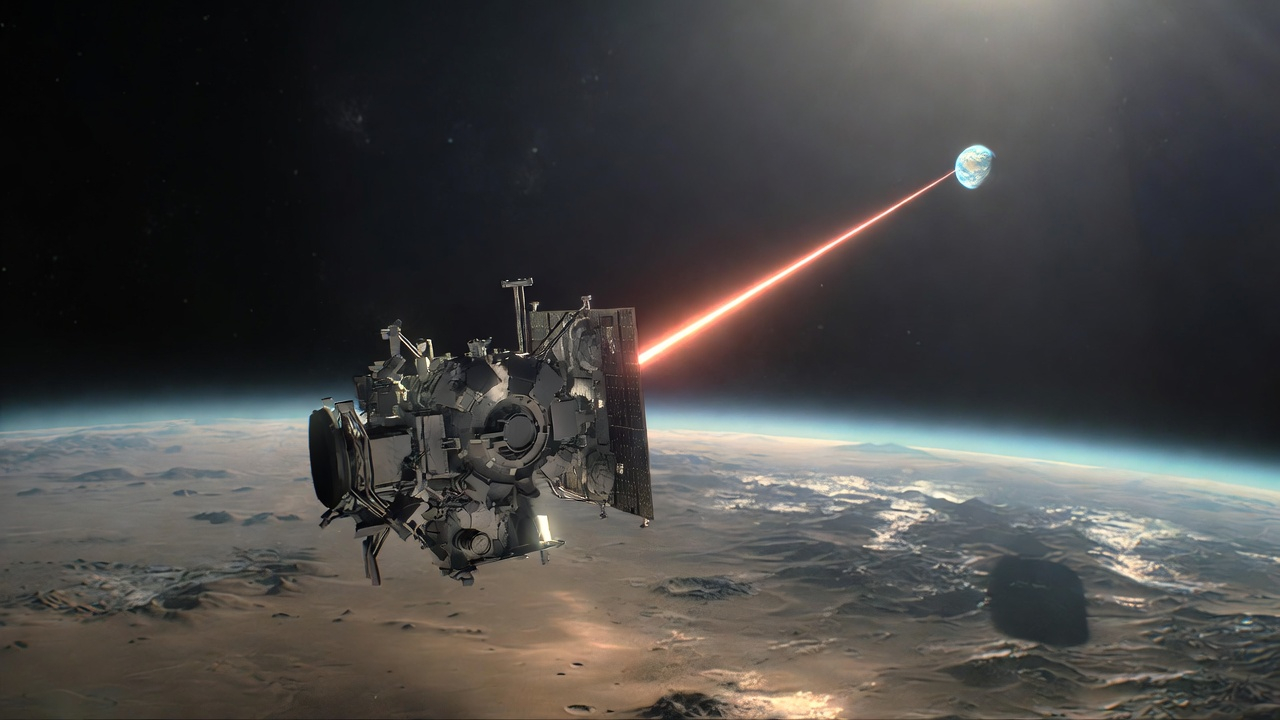

Until recently, communicating with deep space felt like the dial-up era of the 1990s. Data took hours to transmit, and high-resolution photos from Mars rovers “crawled” to Earth at speeds barely sufficient for a text file. However, NASA’s latest tests of the Mars Telecommunications Network have fundamentally changed the game. Data transmission speeds have reached an incredible 100 Mbps.
This is more than just a technical upgrade; it is the infrastructure upon which the first human settlement on the Red Planet will be built.
The Laser Breakthrough: From Radio Waves to Photons
For decades, NASA has relied on the Deep Space Network (DSN)—a global array of giant radio antennas. While radio waves are reliable, they have limited bandwidth. As the number of missions to Mars increases, including Perseverance, Curiosity, and upcoming projects from SpaceX, the network has become congested.
The new system is based on Optical (Laser) Communication. Instead of scattered radio waves, it uses tightly focused laser beams in the near-infrared spectrum.
Why Does This Matter?
- Data Volume: Laser communication allows for 10 to 100 times more data transmission than traditional radio systems.
- Energy Efficiency: Optical terminals are more compact and consume less power, which is critical for spacecraft longevity.
- 4K Video Streams: We can now receive high-quality video from the Martian surface in near real-time (accounting for the light-speed delay).
Deep Space Communication: A Step-by-Step Comparison
To understand the magnitude of this leap, let’s look at how the new Laser (Optical) system compares to traditional Radio Frequency (RF) methods:
- Maximum Data Speed: * Traditional RF: Usually limited to 0.5 – 6 Mbps at Mars distances.
- Optical (Laser): Successfully tested at 100 Mbps, with peaks reaching 267 Mbps.
- Frequency and Precision:
- Traditional RF: Uses X-band or Ka-band waves which spread out over long distances.
- Optical (Laser): Uses Near-Infrared light (1550 nm). The beam is much narrower, meaning more energy reaches the receiver.
- Hardware Efficiency:
- Traditional RF: Requires large, heavy high-gain antennas.
- Optical (Laser): Uses smaller, lighter flight laser transceivers, saving room for scientific instruments.
- Operational Reliability:
- Traditional RF: Can penetrate clouds and most weather conditions on Earth.
- Optical (Laser): Requires clear skies, leading NASA to use multiple ground stations in different geographical locations to avoid cloud cover.
Crucial Context: What Else You Need to Know
While the speed is impressive, there are several “behind-the-scenes” factors that make this technology viable for the 2026-2030 mission window:
- The Psyche Carrier: This technology is currently being tested via the Psyche spacecraft, which is en route to a metal-rich asteroid. This “ride-along” allows NASA to test the laser in real deep-space conditions.
- Ground Signal Capture: NASA’s Jet Propulsion Laboratory (JPL) uses a giant 5.1-meter telescope at Palomar Observatory to “catch” the laser signal from space, converting light back into digital data.
- Hybrid Solutions: Future Mars orbiters will likely use “Hybrid Antennas” that can receive both radio and laser signals, ensuring 100% reliability regardless of weather.
Technical Statistics & Testing Data
- Distance: Recent successful tests were conducted at distances exceeding 31 million kilometers (80 times the distance to the Moon).
- Performance: A single laser session transmitted as much data as 15 years of old-style radio transmissions from similar distances.
- Precision: The laser must point with the accuracy of a person on Earth hitting a dime (small coin) with a laser pointer from 10 miles away.
Glossary of Terms
- Astrobiology: The study of the origin and evolution of life in the universe.
- Exoplanetology: The investigation of planets orbiting stars other than our Sun.
- Regenerative Design: A design process that restores or improves its own sources of energy and materials.
- Social Innovation: Developing new strategies to meet social needs, such as collaborative “Economy of Good” models for space.
- LIDAR: A remote sensing method that uses light in the form of a pulsed laser to measure ranges (distances).
A Message from Our Starry Friends
“When you learn to transmit light as fast as thought, you will realize that distance is merely an illusion. Mars is not another planet; it is simply the next room in your great home. We are watching as you tune your instruments, waiting for the moment your signals become clear enough to hear not just the numbers, but the heartbeat of your civilization. Keep shining.”
Crucial Context: Key Facts to Know
- Host Spacecraft: The experimental hardware is integrated into the Psyche spacecraft, which is currently en route to a unique metal-rich asteroid of the same name.
- Distance Record: As of late 2025 and early 2026, NASA has successfully maintained stable communication at a distance exceeding 350 million kilometers (approx. 217 million miles).
- The Roadmap: In May 2026, the Psyche spacecraft is scheduled to perform a gravity assist maneuver at Mars. This flyby will provide a critical opportunity to conduct a new series of high-speed data tests in the immediate vicinity of the Red Planet.
- Channeled message
- Co-Creation
- Complete Starseed Registry.
- Cosmic vibe
- Extraterrestrial Civilizations
- Gratitude
- Guides of Freedom and Transformation.
- Practice
- Quantum Consciousness
- Spiritual Awakening
- St. Germain
- Teachers, Healers, and Technologists.
- The Egyptian Pantheon of Gods
- The Progenitors and the Architects.
- TrendBeam
- Uncategorized