
Right now, when every morning begins with alarming headlines, it’s easy to fall into a state of “ecological numbness.” It feels like the world is plummeting into an abyss and we are just passengers without a steering wheel. But it is precisely in the epicenter of chaos that Radical Hope is born. This isn’t about rose-colored glasses. It’s about an inner fire and the determination to act as if your step today determines the survival of an entire species. It is a strategy for those who refuse to be victims of circumstance.
Gabriel’s story is not a fairy tale about gardening. It is a tough, successful case study of how business becomes human and how nature transforms from a dead resource into a powerful ally.
The Gardener vs. Concrete: How to Outsmart the Desert
Gabriel wasn’t born with a shovel in his hand. He was a successful architect in a glass skyscraper until he realized he was building sets for a world that was disappearing. Leaving everything behind, he returned to his grandfather’s farm in one of the most sun-scorched regions of Europe.
The land he saw was dead. Decades of chemicals and intensive plowing had turned the soil into something resembling sun-baked asphalt. Neighbors just smiled: “Gabriel, even a weed won’t survive here, don’t waste your time.” But he had a plan based on biomimicry—the science of copying nature’s brilliant engineering solutions.
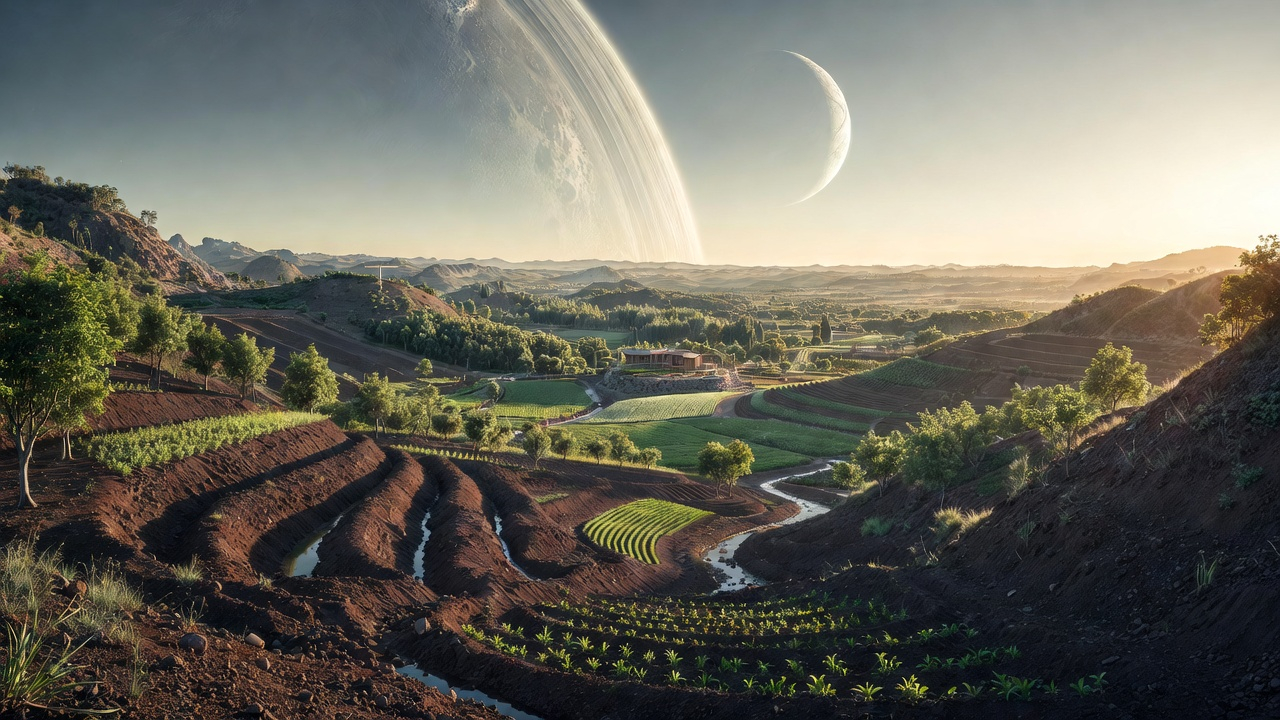
Gabriel understood the main mistake: we are used to fighting drought by pumping water from the depths, whereas we should be teaching the earth to hold it. He stopped plowing. Instead, he began building “swales”—contoured ditches that mimic the structure of a forest floor. When the first rain in a long time fell, the water didn’t just run off into a gully, washing away the remains of the humus. It stayed in these “pockets,” slowly soaking deep into the ground.
He planted “pioneer plants”—thorny, wild grasses with roots that can break through stone. Trees followed. In three years, something happened that the locals called a miracle: in a ravine that had been dry for forty years, a spring broke through. Gabriel didn’t just grow a garden. He brought back the river.
The Economy of Goodness: When a Resource Becomes a Common Good
This story isn’t about a hermit. It’s about a new model of relationships—the Economy of Goodness. When water returned to Gabriel’s land, he didn’t put up a fence and start selling it in bottles. He made the water part of a social contract.
- Regenerative Business: He helped neighboring farmers change their technology, proving that restoring shelterbelts lowers field temperatures by 5°C, saving crops without expensive irrigation.
- Humanity as an Asset: Gabriel created a cooperative where profit is shared not by the number of shares, but by the contribution to restoring the ecosystem. Business became more human because it stopped exploiting and started nurturing.
- Citizen Science: Now, not just workers but volunteer researchers work on his farm. People from all over the world come to document how rare bird species are returning. This is Radical Hope—when you become part of something bigger than your own “I.”
Facts That Speak for Themselves
Today, the numbers confirm: the path of regeneration is the most profitable investment of the decade.
Statistics in a row: Moisture retention in regenerative soil grows to 85% compared to 20% in conventional fields; insect biodiversity increases by 300% over three seasons; the profitability of eco-farms is 18% higher due to the rejection of pesticides; consumer trust in ethical brands in 2026 stands at 72%; the global regenerative design market has grown by 40% over the last two years.
Space and Us: The Astrobiology of Planetary Patriotism
While Gabriel restores rivers, astrobiology and exoplanetology provide the necessary scale. When scientists find a new planet in the “habitable zone,” we feel more than just curiosity; we feel planetary patriotism. We realize how unique our “spaceship” is. The search for life among the stars is a mirror in which we see the value of every blade of grass on Earth.
Terms for a New Era
- Radical Hope – An active stance of creation in crisis conditions, where every action is considered significant for the future.
- Economy of Goodness – A business model that prioritizes ethics and resource restoration over short-term profit.
- Biomimicry – Technologies that copy natural processes to solve human problems.
- Regenerative Design – Designing systems that actively restore ecosystems rather than just minimizing harm.
- Citizen Science – A movement where ordinary people participate in scientific research.
A Message from Star Friends
“You have long searched for us in the void of space, but contact begins here, on your own soil. When Gabriel returned the water to the river, he sent a signal that we heard. Radical Hope is the language of the Universe. Every act of restoration, every planted shelterbelt, every business that has chosen humanity—these are your beacons. You are not alone. You are cells of a living organism that is finally waking up. Do not be afraid to be small. Even a single star breaks the darkness.”
Conclusion
Gabriel’s story is a reminder: the future doesn’t just arrive; it is grown. Radical Hope is the fuel, and the Economy of Goodness is the engine. Don’t wait for global changes. Be like Gabriel. Bring back your river. Create your reality right where you are. Because it is from such small oases that a new, flourishing planet is built.
- Channeled message
- Co-Creation
- Complete Starseed Registry.
- Cosmic vibe
- Extraterrestrial Civilizations
- Gratitude
- Guides of Freedom and Transformation.
- Practice
- Quantum Consciousness
- Spiritual Awakening
- St. Germain
- Teachers, Healers, and Technologists.
- The Egyptian Pantheon of Gods
- The Progenitors and the Architects.
- TrendBeam
- Uncategorized


