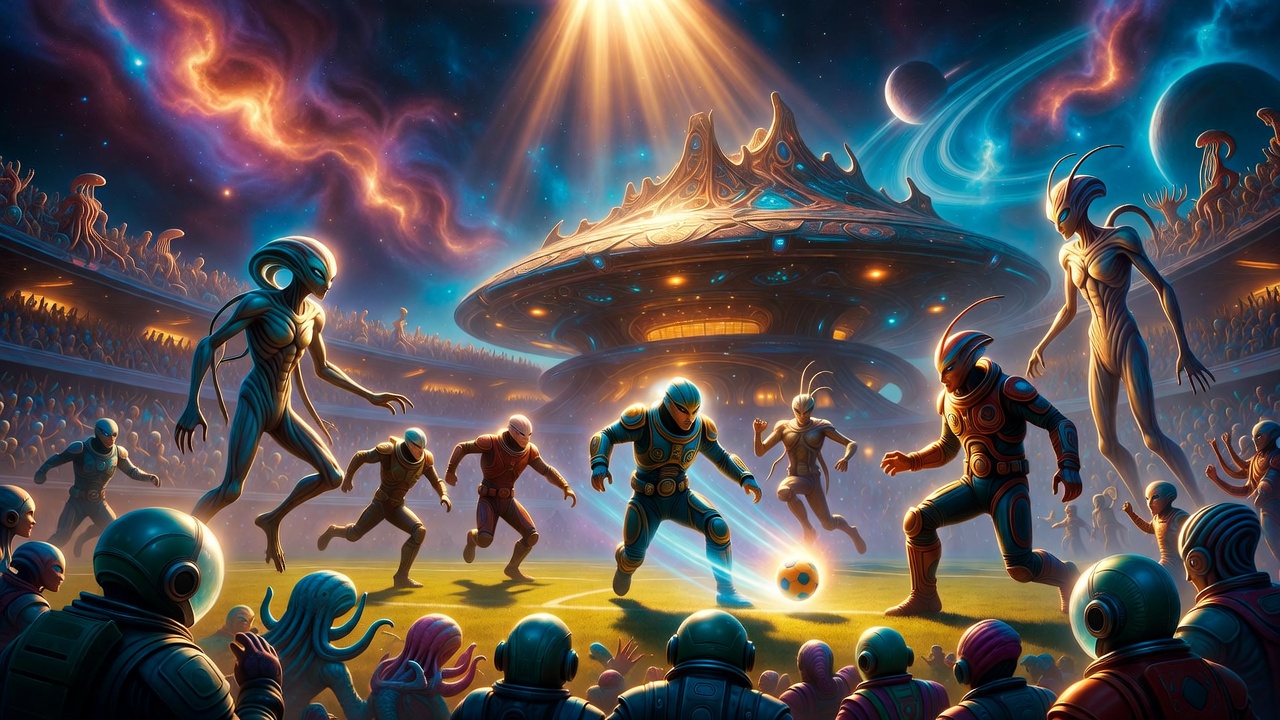

Introduction: A New Era of “The Beautiful Game”
Imagine a world where the boundaries of the football pitch are not limited by white lines on the grass but stretch to the stars themselves. Gravity, which we used to consider a constant, is now just another defender to be bypassed. The ball no longer travels along a parabolic arc—it slices through space according to the laws of quantum physics, and instead of floodlights, the stadium is illuminated by the moons of Saturn. Welcome to the future. Welcome to the era of Space Football.
More than a century has passed since the first human stepped on the Moon, but the true conquest of space did not begin with flags or scientific laboratories. It began when someone took an old leather ball onto the Orion station. What started as a leisure activity for astronauts in their spare time has evolved into the grandest spectacle in human history—the Intergalactic Cup.
The Evolution of the Game: From Turf to Vacuum
The transition from Earthly football to the cosmic version was not instantaneous. It all began with experimental matches on the Moon in the 2080s. Back then, players still wore heavy spacesuits, and matches resembled slow-motion replays. However, the technological leap of the early 22nd century changed everything. The invention of “synthetic atmosphere” and “local gravity stabilizers” allowed players to wear traditional kits while utilizing new physical capabilities.
Today, the Cosmic Football Association (CFA) coordinates thousands of leagues across the Milky Way. Football has become the language spoken by colonies on Mars, miners on the asteroids of the Kuiper Belt, and diplomats on orbital stations.
What are the Rules of Space Football?
While the spirit of the game remains the same—getting the ball into the opponent’s goal—the mechanics of the process have undergone fundamental changes.
- Zero-G & Flux (Variable Gravity) Players are equipped with magnetic boots that allow them to instantly attach to any surface of the spherical stadium, and maneuvering micro-jetpacks integrated into their jerseys. This makes the game three-dimensional. A striker can attack not only from the flanks but also from “above” or “below.” Dribbling has turned into a complex ballet: a player can spin the ball so that it spirals around a defender in zero gravity.
- Atmospheric Conditions and “Home Field Advantage” In space football, the concept of home field is critical:
- Martian Arenas: Due to the thin atmosphere, the ball flies significantly faster. Players must calculate strikes with millimeter precision; otherwise, the projectile will simply fly out of the dome.
- Jupiter Orbit Stations: Artificial high gravity is used here to simulate Earth conditions, but due to the planet’s magnetic field, the ball sometimes behaves chaotically, picking up a static charge.
- “Asteroid” Goals and Energy Zones Classic goalposts are a thing of the past. Modern goals are dynamic energy fields. Depending on the stage of the match (e.g., during “Golden Minutes”), the goal can slightly change its geometry or become “transparent” to the ball only under a specific strike force. This requires forwards to possess not only accuracy but also an intellectual calculation of shot energy.
✨ Technological Revolution: Galactic VAR
Disputes over a “clean goal” or “offside” on Earth seem like child’s play compared to the challenges of space. The Intergalactic Cup utilizes a Quantum Tracking system.
A network of AI satellites surrounds the stadium, tracking the position of every atom of the ball and every joint of a player 100,000 times per second. If a controversial moment occurs, the head referee activates a local stasis field. The audience (both in the stadium and via holographic broadcasts) watches as time stops. The referee literally steps inside the frozen moment, walking around players, looking from any angle, and even “rolling back” a collision simulation to determine if it was a play on the ball.
This has eliminated corruption and errors but added incredible theatricality to the game. No one screams at the referee anymore—everyone simply waits for the verdict of the Universe.
Intergalactic Cup: Battle of the Worlds
Every four Earth years, the entire galaxy stands still. The Intergalactic Cup begins—a tournament where not just teams, but different philosophies of survival and development clash.
- “Martian Meteors” A team raised in low-gravity conditions. Their style is speed. They don’t hold the ball long; they use “rebound football,” bouncing the ball off the walls of the spherical stadium so fast that the human eye can barely follow. Their captain is a legendary striker who, rumors say, trained by chasing meteorites in the asteroid belt.
- “Jovian Giants” These are athletes accustomed to high pressure. Their game is based on power. They use heavy strikes that literally “pierce” the energy shields of the goals. Playing against them is like trying to stop a cargo shuttle at full speed.
- “Earth Legends” Earthlings remain masters of strategy and classical technique. Despite the fact that they may be physically outmatched by the colonists, their understanding of pitch geometry and team chemistry makes them favorites in any tournament.
The Psychology of the Game: Loneliness of the Goalkeeper in Zero-G
Space football has also changed the players’ mentality. Being a goalkeeper in space is the toughest job in the universe. You need to track a ball that can come from any point in a 360-degree sphere. This requires not only reaction speed but also advanced spatial reasoning. Many goalkeepers use neuro-interfaces for instant communication with the stadium’s AI to predict flight trajectories.
A Symbol of Unity and the Future
Space football is more than a sport. It is a bridge between planets. Imagine the final: billions of beings across different ends of the galaxy hold their breath simultaneously, watching a holographic screen. In that moment, it doesn’t matter if you were born under the sun of Earth or under the artificial lamps of a starship. All that matters is whether the ball crosses the goal line.
It is proof that humanity, despite all conflicts and vast distances, has preserved its passion. Even in the icy void of space, we were able to ignite the fire of sporting excitement. Space football teaches us cooperation: one player’s jetpack might fail, and only a teammate’s timely pass can save the attack. It is a metaphor for our survival as a species among the stars.
Conclusion: Your Turn to Take the Field!
Today we only dream of this, looking at pixelated screens and yesterday’s trends. But somewhere out there, among billions of stars, the first stadium is already being built, where stardust will replace grass.
Who do you think will be the first to lift the Intergalactic Cup over their head? Can Earthly technology defeat Martian speed? What would you name your star team, and which planet would you choose for your home stadium?
Leave your ideas in the comments. Perhaps your comment will become the basis for the charter of the future Galactic Football Federation! 👇
- Channeled message
- Co-Creation
- Complete Starseed Registry.
- Cosmic vibe
- Extraterrestrial Civilizations
- Gratitude
- Guides of Freedom and Transformation.
- Practice
- Quantum Consciousness
- Spiritual Awakening
- St. Germain
- Teachers, Healers, and Technologists.
- The Egyptian Pantheon of Gods
- The Progenitors and the Architects.
- TrendBeam
- Uncategorized


