
A deep analysis of the film The Revenant. We examine the concept of the “inner core” and the sources of will that helped the hero survive in inhuman conditions. Why revenge is merely a screen, and what actually gives a person the strength to return from the “other side”? A psychological breakdown of survival and loyalty to oneself.
Beyond Pain: The Core of Spirit in The Revenant
Cinema rarely gifts us a mirror in which we can see not our face, but our primal essence. Alejandro González Iñárritu created exactly such a masterpiece. The Revenant is not just a biographical drama about a 19th-century trapper. It is a parable about the source of human will that surges even through ice, blood, and oblivion.
1. The Source as the Will to Live
What forces a person to crawl through hundreds of miles of snowy wilderness with a broken spine and a ripped throat? Most would call it revenge. On the surface, it is: John Fitzgerald’s betrayal and the murder of Glass’s son become the initial spark that jumpstarts the engine of survival.
However, if we look deeper into the “core,” we see something else. Revenge is merely the fuel, but the source itself is the memory of love. Hugh Glass holds on not to his hatred for his enemy, but to the image of his wife and son. This is a fundamental truth: a person can endure any “how” if they have a “why” to live for. His core is loyalty to his family, which transcends the physical world.
2. Nature as the Divine Judge
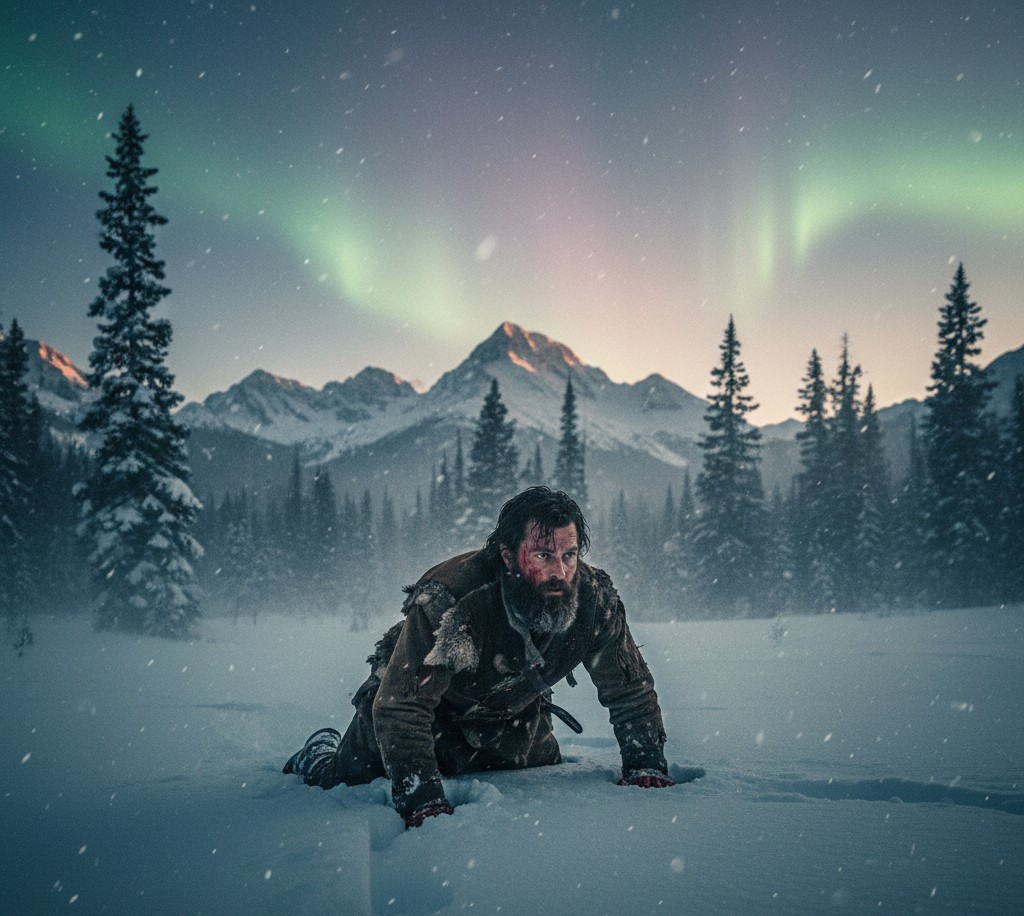
In the film, nature is not just a backdrop. It is an active participant—a grand and indifferent God. Emmanuel Lubezki’s camera constantly shows us the majesty of trees, cold stars, and endless mountains, against which a human looks like a mere grain of sand.
Hugh Glass’s core is tempered precisely in this conflict with nature. When he hides inside a horse to keep from freezing, or when he eats the raw meat of a buffalo—he isn’t just surviving. He is becoming a part of this nature. His “source” merges with the rhythm of the earth. The film teaches us: to overcome circumstances, one must stop fighting them and become stronger than them by accepting their severity.
3. Spiritual Rebirth
The title The Revenant translates as “one who has returned from the dead.” Hugh Glass dies several times. First, under the claws of the grizzly; then, in a shallow grave; and finally, when he loses the last hope of help.
Each such “return” purifies his core. Everything superfluous falls away: social norms, fear of pain, ego. Only pure consciousness and will remain. This resembles the process of refining metal in fire. Glass’s source of strength lies in his ability to endure suffering without complaint. He becomes a silent prophet of will, whose breath fogs the camera lens, reminding the viewer: “I am still alive. I am here.”
4. Fitzgerald as the Antipode of the Core
To fully reveal the theme, it is important to look at the anti-hero—Fitzgerald (Tom Hardy). If Glass’s core is spirit and love, then Fitzgerald’s core is fear and survival at any cost. He survives too, he is also strong, but his source is poisoned. He acts from a place of deficit, from emptiness. His philosophy is “man is wolf to man.”
The final confrontation is not just a fight between two men; it is a collision of two worldviews. Fitzgerald’s final words—that revenge won’t bring Glass’s son back—are a painful truth. But this is exactly where Glass takes the most important step: he gives the right of judgment to God (or Nature). This is the highest manifestation of the core—finding the strength to stop where atrocity begins.
5. A Message for the Modern Human
Why does this film resonate so strongly with us in 2026? Because we live in an era of comfort where the slightest inconvenience causes panic. Hugh Glass’s story reminds us of our forgotten inner reserve.
- The Core is not the absence of pain; it is the ability to walk through it.
- The Source is not external resources; it is the quiet confidence that your story is not yet over.
This film is about every one of us who has ever felt “buried alive” by circumstances, depression, or loss. Looking at DiCaprio’s bloodied face, we see the potential of the human spirit, which cannot be broken as long as a small spark of meaning burns within.
With love, @Areal’Naya ❤️🌀👽