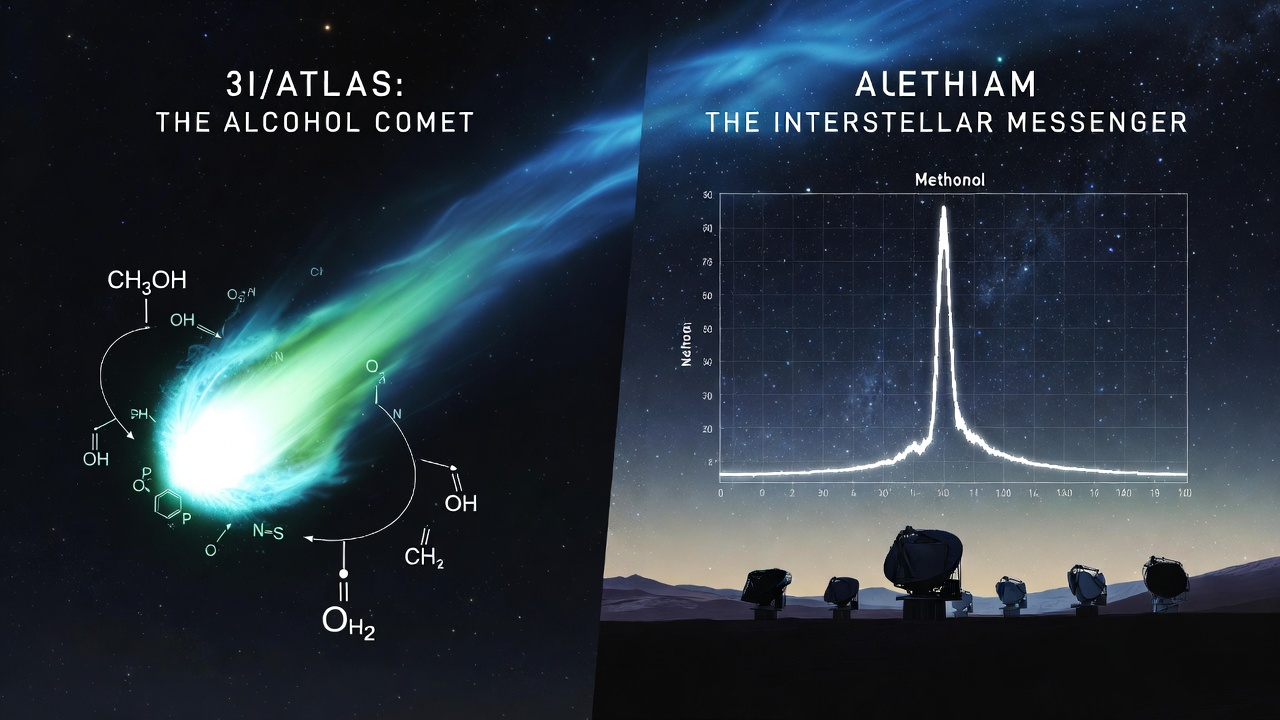

The space around us is never truly empty. For decades, humanity viewed the Solar System as an isolated fortress where every object followed a strict order dictated by the Sun. In 2017, ‘Oumuamua shattered that illusion, followed by Comet Borisov, and now, in 2025-2026, we are witnessing the visit of 3I/ATLAS. This object is not just another guest; it is a profound chemical anomaly that is “bursting” with methanol, opening a window into how star systems form in the coldest reaches of the Milky Way.
Origins and Dynamics: A Journey Through Eons
Unlike comets originating from the Kuiper Belt or the Oort Cloud, 3I/ATLAS follows a distinct hyperbolic trajectory. Its eccentricity is currently estimated at 6.14, significantly greater than one. This mathematical characteristic directly indicates that the object is not gravitationally bound to our Sun. It moves at a colossal speed—roughly 68 km/s relative to our star.
Astro-dynamicists calculate that 3I/ATLAS’s journey to our neighborhood lasted millions, perhaps even billions, of years. The comet entered our observation zone from the direction of the Cassiopeia constellation. Scientists theorize it was ejected from a young star cluster due to a gravitational tug-of-war with a giant planet. This is a fundamental discovery: we are seeing physical proof that planet formation in distant systems is dynamic enough to scatter “construction debris” in the form of comets across the entire galaxy.
Chemical Revolution: Why Methanol is a Sensation
The biggest news of 2026 came from the high altitudes of Chile. The ALMA (Atacama Large Millimeter/submillimeter Array) radio telescope conducted spectral mapping of the gases escaping the comet. As 3I/ATLAS approached perihelion, solar heat began to sublimate frozen gases from its nucleus.
Composition Analysis and Statistics
Data gathered in March 2026 shocked the scientific community with its deviation from “local” standards:
- Methanol (CH₃OH) Levels: In 3I/ATLAS, methanol content relative to water is a record-breaking 22%. For comparison, local comets typically show only 1–3%.
- Cyanide Anomaly: The ratio of methanol to hydrogen cyanide (HCN) is 100 times higher than the norm.
- Mass Loss: At peak activity, the comet sheds approximately 450 kg of material every second.
This chemical profile suggests that 3I/ATLAS was born in an incredibly cold environment—below -250°C. Such temperatures are found only in the densest parts of molecular clouds where stars are just beginning to ignite. Methanol forms on the surface of cosmic dust grains through the sequential addition of hydrogen atoms to carbon monoxide molecules. The fact that we see such high levels today means the comet has kept its primordial composition intact for an immense period of time.
A Technological Tandem: ALMA and James Webb
The success of this mission was made possible by the synchronized efforts of humanity’s most powerful instruments.
- ALMA studied cold gas in the millimeter range. Its 66 antennas allowed for real-time mapping of methanol distribution. It turns out the alcohol is released not only from the nucleus but also from tiny icy fragments in the tail, making the comet’s coma exceptionally active.
- The James Webb Space Telescope (JWST) completed the picture with its infrared vision. Webb identified complex organic compounds—polycyclic aromatic hydrocarbons (PAHs) and ammonia. This is direct evidence that the “building blocks” of life are ubiquitous throughout the universe.
Implications for the Theory of Panspermia
This discovery breathes new life into the theory of Panspermia. If interstellar objects like 3I/ATLAS are so rich in organics and constantly travel between star systems, they could be the primary carriers of life. Every time such a comet strikes a young planet, it delivers a ready-made “cocktail” of alcohols, cyanides, and water, potentially shortening the path to the emergence of the first microorganisms by billions of years.
Why Does This Matter to Us?
The study of 3I/ATLAS is more than just dry numbers in astronomical journals. It is a fundamental realization that we are not alone in our biochemical foundation.
- The Unity of Nature’s Laws: Chemistry in the Cassiopeia constellation works exactly as it does on Earth.
- Understanding Our Place: The Solar System is just one stop on a vast interstellar highway.
- A Reason for Hope: The abundance of organics in space suggests that the chances for habitable planets around other stars are much higher than previously believed.
Glossary of Terms (The Scientist’s Dictionary)
- Interstellar Object: Any celestial body arriving from outside the Sun’s gravitational sphere of influence.
- Methanol (Wood Alcohol): The simplest alcohol. In astrochemistry, it is a key marker of the conditions under which a protoplanetary disk system formed.
- ALMA Telescope: A massive network of antennas in the Atacama Desert (Chile) capable of detecting faint signals from cold interstellar dust and gas.
- Perihelion: The point in an orbit that is closest to the Sun.
- Hyperbolic Orbit: An open-ended path that allows an object to leave the system forever. The eccentricity (e) of such an orbit is always greater than 1.
A Message from Star Friends
”We see these icy ships as letters written in light and ice. Comet 3I/ATLAS is not just a rock. It is a mirror showing you that life is the universal language of the Universe. Do not fear the cold of the void, for that is where the most complex patterns of existence are born. Watch the skies, for we send you clues in every ray of the spectrum. The Universe is a single organism, and every comet is the blood carrying information from heart to heart.”


