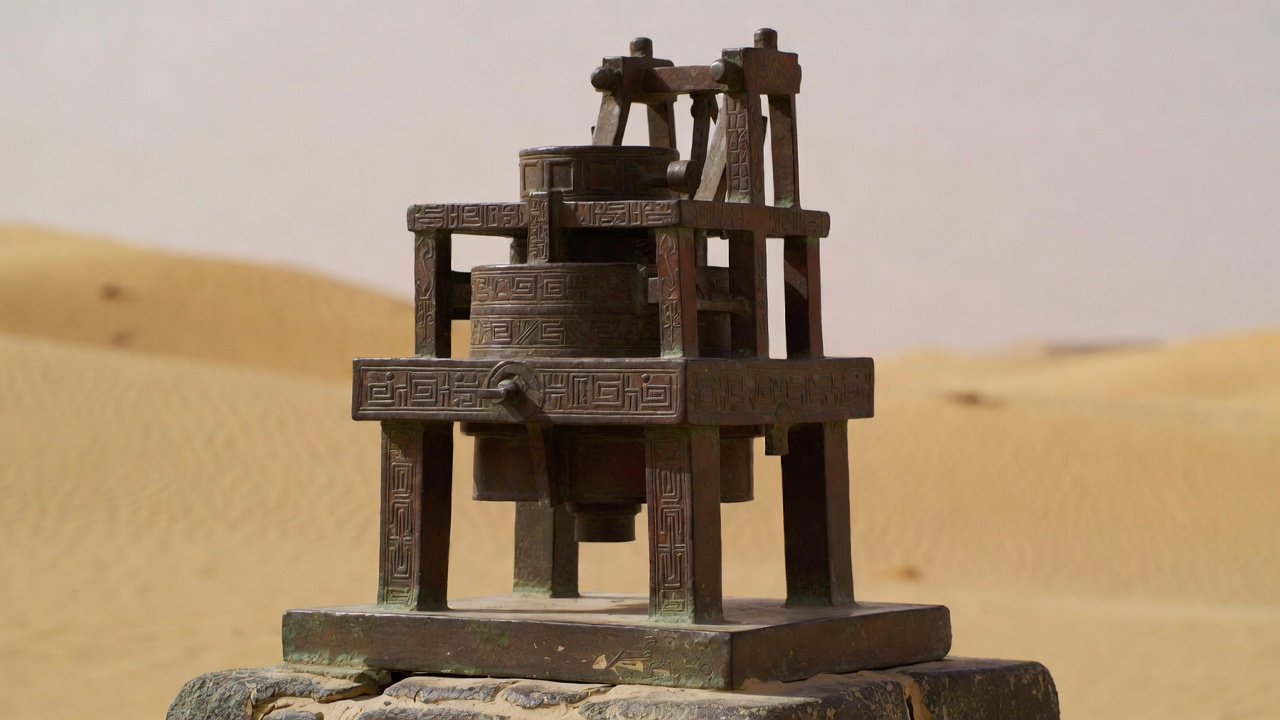

For centuries, Ancient Egypt was perceived as a civilization that emerged almost instantaneously in all its grandeur. When we recall the engineering feats of the Nile Valley, the mind conjures images of the Great Pyramids of Giza or the colossi of Luxor. However, the latest archaeological research of 2026 forces us to look much deeper into time—to an era that preceded the first pharaohs. The identification of remains of a Pre-Dynastic copper drilling machine has become the missing piece of the puzzle, explaining exactly how the Egyptians achieved such an incredible level of stonework.
A Technological Leap: From Flint Knives to Mechanisms
Until recently, it was believed that Pre-Dynastic Egypt (approx. 4000–3100 BCE) was a period of gradual transition from stone tools to primitive copper. Archaeologists found exquisite diorite and basalt vases, but the question of “how exactly were they made?” remained open. Working with hard stone types requires more than just physical strength; it demands stable torque and effective abrasives.
A new find in the area of ancient Hierakonpolis (Nekhen) demonstrates that stationary or semi-stationary drilling devices existed even then. This “machine” was not a complex engine in the modern sense, but it was an ingenious mechanical solution using a system of flyweights and copper tubular drills.
Construction and Principle of Operation
Using traceological analysis (the study of wear patterns), researchers have reconstructed a model of this device. The base consisted of a vertical shaft to which heavy stone weights—a prototype of the modern flywheel—were attached. This allowed for the maintenance of rotational inertia, which is critical when working with hard granite or quartzite.
The key element was the copper tubular drill. Copper itself is a soft metal and cannot cut stone. The secret lay in the use of an abrasive—fine quartz sand or emery—moistened with water. The copper tube merely held the abrasive grains, which, under the pressure of the flyweight, literally “bit” into the rock.
Why This Matters:
- Precision: The discovered artifacts feature perfect cylindrical holes with feed marks (thread-like traces) that were previously attributed to much later epochs.
- Speed: The presence of a mechanical drive (likely a bow or strap drive) increased processing speed tenfold compared to manual friction.
- Standardization: The use of such machines indicates the existence of professional workshops rather than isolated craftsmen.
The Social Aspect: The Dawn of the “Economy of Craftsmanship”
This discovery changes not only the history of technology but also our understanding of the social structure of that society. The creation of a copper drilling machine required:
- Metal Mining and Smelting: Indicating advanced logistics with the Sinai Peninsula.
- Mathematical Calculation: It was necessary to balance the weight of the flywheels to prevent axis vibration.
- Division of Labor: The master who built the machine and the craftsman who operated it were likely different individuals.
This was the beginning of what we today call an industrial approach. “Business” at that time (if we can call temple or chieftain workshops that) was becoming systemic. It was an integration of knowledge about materials and mechanics to create products of sacred and prestigious significance.
Solving Mysteries: Impact on the Construction of the Pyramids
Many proponents of alternative history have claimed that the pyramids were built using lasers or alien technology because “a copper chisel cannot cut granite.” The Pre-Dynastic drilling machine puts an end to these debates.
It proves that 500–800 years before Khufu, the Egyptians had already mastered the principles of abrasive drilling and the use of torque. The Great Pyramids did not appear out of thin air—they were the result of centuries of evolution in engineering thought that began with small copper tubes and stone flywheels in the pre-literate period.
Archaeology of the Future: Digital Restoration of the Past
Today, thanks to 3D scanning and computer modeling, we can see these mechanisms in motion. Archaeologists use AI to analyze microscopic scratches on the inner walls of ancient vases to determine the rotation speed and the type of abrasive used millennia ago.
Interestingly, the principles embedded in these first machines are still used today in diamond core drilling. This reminds us of the continuity of human genius: we are merely refining what was invented on the banks of the Nile over five thousand years ago.
Summary
The discovery of the Pre-Dynastic copper machine is a reminder that human history is much more complex and fascinating than we usually think. It is a story of innovations born of necessity and of masters whose names are forgotten, but whose legacy is carved in stone for eternity.
Link Name : https://discoveringegypt.com/ancient-egyptian-inventions/